What is the Difference Between 2D, 3D, 4D, 5D and 6D Ultrasound for Pregnancy?

Ultrasound technology during pregnancy has evolved significantly, ranging from standard 2D imaging—which produces flat, black-and-white cross-sectional views—all the way to advanced 6D technology that leverages high-definition rendering and AI-enhanced image processing. In simple terms, 3D adds depth to create still surface images, 4D introduces live-streaming video to capture fetal movement in real time, while 5D and 6D refine lighting, skin tones, and clarity to produce remarkably realistic and lifelike images of the unborn baby. It is important to understand that 2D remains the primary diagnostic tool used by medical professionals, whereas the higher dimensions (3D through 6D) are largely intended for parental bonding and keepsake purposes.
Congratulations! You are pregnant, and you have likely heard a flurry of technical terms from your doctor, your friends, or social media. One of the most common sources of confusion for expectant parents is the difference between a 2D, 3D, 4D, 5D, and 6D ultrasound. Walk into any boutique ultrasound clinic, and you will see packages for all of these “dimensions,” often with wildly different price tags.
But what do these terms actually mean? Is a 6D ultrasound really six times better than a 2D? Are these scans safe for your baby? And why does your hospital only use the “old” black-and-white 2D version while private clinics offer 5D “HD” videos?
In this comprehensive guide, we will break down the technical differences, safety concerns, medical necessity, costs, and the best timing for each type of pregnancy ultrasound. By the end of this article, you will know exactly which scan to book, when to book it, and whether the higher “D”s are worth your money.
What is the Difference Between 2D, 3D, 4D, 5D and 6D Ultrasound for Pregnancy?
Let us start with the core question. The number before the “D” (which stands for Dimensional) refers to how many planes of movement the sound waves use to construct an image.
2D Ultrasound (The Medical Standard)
What it is: Two-dimensional ultrasound uses a single flat plane of sound waves. It produces a black-and-white image that looks like a cross-section of your uterus.
What you see: Gray, blurry shapes. To the untrained eye, it looks like static on an old TV. However, a trained sonographer can see the internal organs, bones, and heart chambers.
Primary use: 100% of medical diagnostics. This is the only scan doctors trust for measuring growth, checking the placenta, and detecting anomalies.
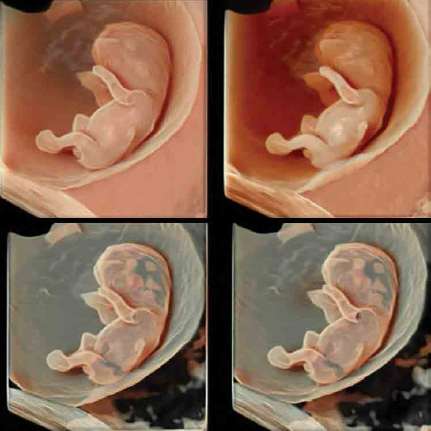
3D Ultrasound (The Still Portrait)
What it is: Instead of a single flat plane, the machine captures sound waves from multiple angles (three planes: height, width, and depth). A computer then stitches these together to create a still, three-dimensional photograph.
What you see: A still, golden or sepia-toned image of your baby’s skin surface. You can see the curve of the nose, lips, and eyelids.
Primary use: Bonding and elective keepsakes. It helps parents visualize the baby’s face, but it does not show movement.
4D Ultrasound (The Live Movie)
What it is: This is essentially 3D in real-time. The machine takes multiple 3D images per second and plays them back as a video.
What you see: A moving video of your baby yawning, sucking their thumb, kicking, or turning their head.
Primary use: Emotional bonding and family viewing. This is the “live action” version of the 3D still.
5D Ultrasound (The Enhanced Filter)
What it is: This is a marketing term, not a medical one. 5D takes a 4D video and applies a software algorithm to enhance the skin tones, remove shadows, and add a realistic “flesh” tone texture.
What you see: A high-definition, rosy-colored video where the baby looks almost like a real photograph rather than a sonogram.
Primary use: Boutique “keepsake” imaging. It is often called “HDlive” or “Realistic 5D.”
6D Ultrasound (The AI Motion Tracker)
What it is: Currently the highest commercial marketing term. 6D adds motion tracking and automated rendering to the 5D image. The software follows the baby’s movement automatically, keeping the image in focus without the technician manually adjusting the probe constantly.
What you see: A very smooth, high-definition video with realistic lighting that tracks the baby even when they move quickly.
Primary use: Premium boutique experiences.
Summary Table of Differences:
| Feature | 2D | 3D | 4D | 5D | 6D |
|---|---|---|---|---|---|
|
Image Type |
Cross-section |
Still photo |
Moving video |
Enhanced video |
AI-tracked video |
|
Color |
Black & White |
Sepia/Gold |
Sepia/Gold |
Flesh tones |
Flesh tones |
|
Medical Use |
Yes (Standard) |
No |
Rare |
No |
No |
|
Shows Movement |
No |
No |
Yes |
Yes |
Yes |
|
Realism |
Low |
Medium |
Medium |
High |
Very High |
Is 5D or 6D Ultrasound Safe for My Baby?
The short answer is: Yes, provided it is done by a trained professional for a reasonable amount of time.
The long answer: Ultrasound technology, regardless of the “D,” uses high-frequency sound waves, not radiation (like X-rays). The FDA has approved ultrasound as safe for medical use for decades.
However, the FDA does not approve 5D or 6D “keepsake” ultrasounds. Here is why:
- Heat: Sound waves create a small amount of heat in the tissue. Medical scans are kept short (15–20 minutes). Boutique sessions can last 45–60 minutes, which theoretically could raise tissue temperature.
- Operator error: In a hospital, a certified sonographer knows how to keep the thermal index low. In a boutique mall, the technician may turn up the power to get a prettier picture.
Expert Verdict: A single 15-minute 5D or 6D scan at a reputable boutique is likely safe. However, frequent (weekly) long sessions are not recommended. Stick to the “keepsake” rule: once or twice per pregnancy, for less than 30 minutes.
Which is better — 4D or 5D ultrasound for seeing baby’s face clearly?
Winner: 5D Ultrasound.
If your goal is to see if the baby has your nose or to check for a cleft lip visually, 5D is superior. The “HD rendering” removes the grainy “noise” that 4D images often have. 5D provides better lighting contrast, making the boundaries between the baby and the amniotic fluid much clearer.
However: If you want to see movement (yawning, kicking), 4D and 5D are identical in terms of motion capture; only the texture of the skin changes.
Can my doctor see medical problems on a 5D or 6D scan?
Absolutely not. This is the most critical distinction in this article.
Doctors diagnose medical problems exclusively on 2D ultrasound. Here is why:
- Internal organs: 2D allows the sonographer to see inside the heart valves, the brain ventricles, and the kidney structure. 5D/6D only shows the outside surface (skin).
- Measurements: 2D provides precise mathematical measurements (femur length, head circumference). 5D/6D software can distort edges, making measurements inaccurate.
- Bone shadows: 2D is excellent at seeing the spine and ribs. Higher dimensions often wash out these details.
Rule of thumb: If your doctor orders a scan to check for Down syndrome markers or heart defects, you will get a 2D scan. Do not let a boutique clinic tell you their 5D machine can “spot problems.” They legally cannot (and should not) provide a medical diagnosis.
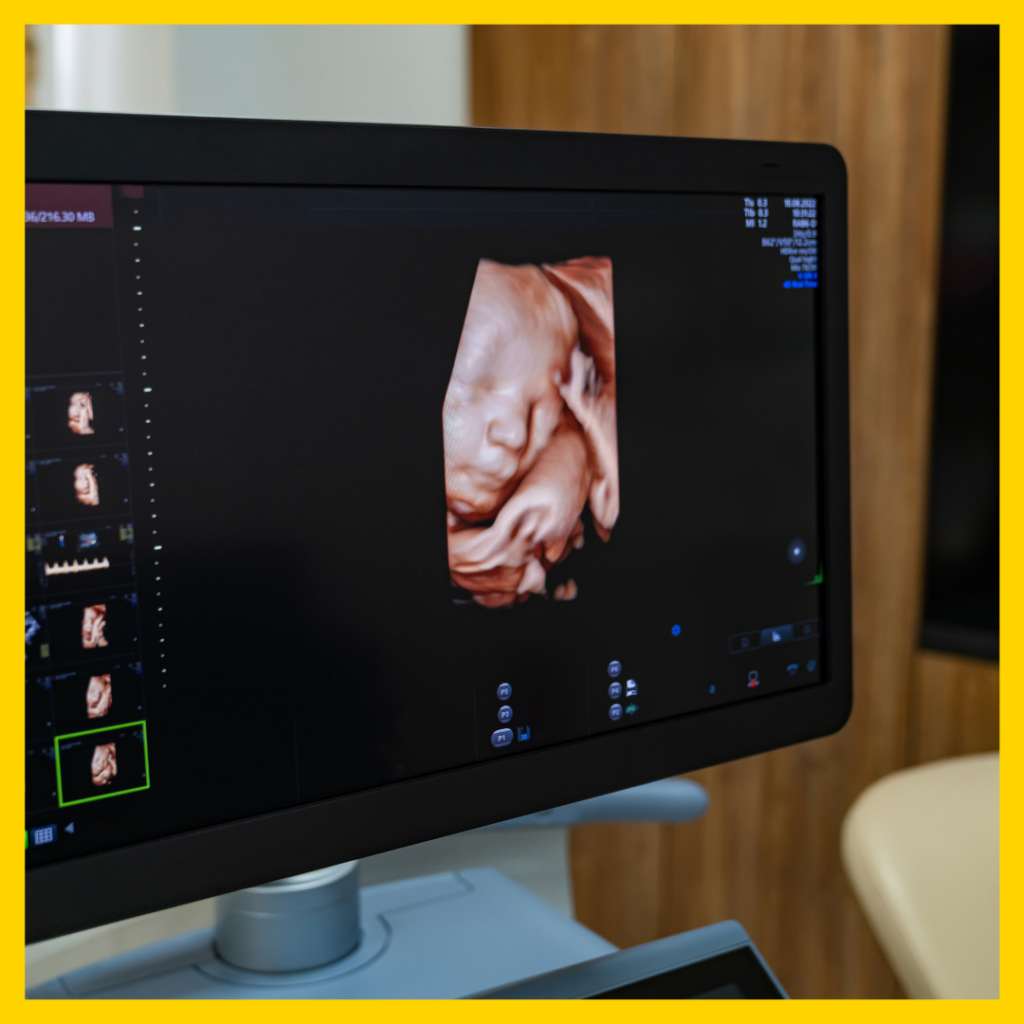
At what week of pregnancy should I get a 3D, 4D, 5D, or 6D scan?
Timing is everything. If you go too early, the baby has no fat and looks like a skeleton. Too late, the baby is too crowded to see.
- Weeks 12–16: Too early. The baby is translucent, and you will just see bones. (Stick to 2D for the NT scan).
- Weeks 24–28 (The “Sweet Spot”): BEST TIME. The baby has developed a layer of fat under the skin but still has plenty of amniotic fluid to move around. The face looks plump and cute.
- Weeks 30–34: Acceptable, but the baby is getting cramped. You may only get partial face shots (hands covering the face).
- Week 36+: Very difficult. The baby is head-down and wedged into the pelvis. You likely will only see the back of the head.
Recommendation: Book your 5D or 6D session between 26 and 30 weeks for the classic “baby face” photo.
Why do hospitals only use 2D ultrasounds when 3D/4D/5D/6D exist?
This is a question of diagnostic accuracy versus aesthetics.
Hospitals are not in the business of creating pretty pictures; they are in the business of saving lives and detecting problems.
- Speed: A 2D scan takes 10 minutes to check the baby’s anatomy. A 4D/5D scan requires the baby to be still and facing the right way, which can take 45 minutes of waiting.
- Artifacts: 5D software “guesses” what the missing pixels should be to make the skin look smooth. In medicine, you cannot guess. A 2D image is raw, unaltered data.
- Cost of equipment: A hospital has to buy many probes for different uses (heart, vaginal, vascular). A boutique just buys one pretty-face probe.
Hospitals have 3D/4D probes on their machines, but they turn them on for only 30 seconds to show the parent the face at the end of a medical exam. They do the entire diagnosis in 2D.
Do I need a referral or prescription for a 5D or 6D pregnancy scan?
No. Since 5D and 6D scans are considered non-medical (“souvenir” or bonding scans), you do not need a doctor’s referral or prescription.
You can book directly online or via phone with a boutique ultrasound provider. However, please note the standard disclaimer: “This is not a medical examination. Please consult your doctor for a medical diagnosis.”
If you require a diagnostic 2D scan for medical purposes, a referral from your OB/GYN may be required.
How much does a 5D vs 6D ultrasound cost, and does insurance cover it?
Prices in Malaysia (Based on Sonobee Ultrasound 2026):
2D Medical Scan (Growth / Basic): RM25 – RM50
4D Scan: RM65 – RM120
5D Ultrasound: RM75 – RM150
6D Ultrasound (Silhouette): RM90 – RM160
⭐Best Value
VIP / Premium Packages
- VIP Gender Scan : RM75.00 – RM 85.00
- VIP 2D Growth Scan : RM100.00 – RM120.00
- VIP 4D/5D Scan : RM250.00 – RM300.00
- VIP 6D Scan : RM250.00 – RM300.00
- VIP Anatomy + 4D/5D Scan : RM550.00 – RM750.00
- VIP Anatomy Scan : RM350.00 – RM450.00
Prices may vary depending on weekday/weekend, location, and package inclusions.
5D and 6D scans are elective and not considered medical necessities, so they are not covered by insurance.
What is the real difference between 4D, 5D, and 6D — or are they just marketing names?
Honest truth: They are 95% marketing names.
The physics of the sound waves has not changed. A “6D” machine uses the exact same sound frequency as a “4D” machine. The difference is the software and processing power.
- 4D = Raw 3D video.
- 5D = 4D + Instagram filter (skin smoothing, color tint).
- 6D = 5D + Face tracking (like your iPhone camera tracking a face during a video).
Clinics invent new “D”s every few years to justify charging higher prices. There is no international science board that regulates what “6D” means. One clinic’s 6D might be another clinic’s 5D.
Verdict: Do not pay a premium for “6D” unless you see a side-by-side comparison that genuinely looks better to your eye. For most parents, a good 4D or 5D is more than sufficient.
Which One Should You Choose?
- For medical safety & diagnosis: You need a 2D ultrasound with your OB/GYN.
- For a cute photo to show grandma: Get a 3D still image.
- For a video of baby moving: Get a 4D scan.
- For the most realistic skin tone: Get a 5D scan (the current sweet spot of quality vs. price).
- For bragging rights and AI tracking: Get a 6D scan, but know you are paying for software, not science.
Ready to see your baby in stunning 5D/6D clarity? Book your scan today and create a beautiful bonding experience you’ll never forget. At Sonobee Ultrasound, various packages are offered such as 2D, 3D, 4D, 5D, 6D, Anatomy Screening and NT scan—so you can choose what suits your pregnancy journey best. Our packages are affordable, quick, and designed for your comfort—perfect for capturing those precious moments before your baby arrives. Limited slots are available daily, so secure your preferred time now.
👉 Book your scan with Sonobee Ultrasound to gain clearer insights into your baby’s development.

🩺 Book Your Early Pregnancy Scan With Sonobee
Take the next step towards confident pregnancy care.
✨ Check your baby’s heartbeat
✨ Meet certified sonographers
✨ Comfortable & mother-friendly experience
.
Frequently Asked Questions (FAQ)
1. Is 6D ultrasound better than 2D for medical checks?
No. 2D is the gold standard for medical checks. 6D is only for pretty pictures.
2. Can 5D ultrasound determine the gender?
Yes, but so can 2D. Gender is determined by looking at the genital tubercle (a 2D measurement), not the skin texture.
3. Will my baby feel the 6D ultrasound waves?
Babies can hear the Doppler sound and may move away from the heat if the scan is too long, but they do not feel “pain” from sound waves.
4. How long does a 6D ultrasound take?
Typically 30 to 45 minutes, though the active scanning time should be less than 30 minutes for safety.
5. Can I eat before a 5D ultrasound?
Yes. Eating increases the baby’s blood sugar and movement, which is good for 4D/5D/6D scans.
6. Why did my 5D scan look bad?
Likely due to low amniotic fluid, anterior placenta (blocking the view), or the baby facing your spine. The technician cannot force the baby to turn.
7. Do twins look good in 5D?
Sometimes, but it is difficult. Twins have less space, so you usually get overlapping limbs and faces pressed together.
8. Is there a 7D ultrasound?
Currently, no mainstream machine exists. “7D” is usually a marketing gimmick for a specific software patch. Stop at 6D.
9. Does drinking juice help the 4D/5D scan?
Yes. A sugary drink (orange juice) 30 minutes before the scan often wakes the baby up and makes them move their hands away from their face.
10. Can I record my 5D ultrasound on my phone?
Most clinics allow it, but they also provide a digital video file (MP4) and printed photos as part of the package.
Disclaimer: This article is for informational purposes only and does not constitute medical advice. Always consult your obstetrician or a certified medical sonographer for medical decisions regarding your pregnancy.